The King's Move: Arm Wrestling's Most Controversial Weapon
In the world of professional arm wrestling, few techniques are as polarizing as the King's Move. It's a defensive strategy that can turn a near-loss into a grueling victory, but its unconventional mechanics have made it a subject of endless debate. Is it a brilliant use of leverage, or is it "ugly" arm wrestling that borders on rule-breaking? Let's dive into its origins and how it's executed.
The Origin Story: From Injury to Innovation
The King's Move wasn't invented in a lab; it was born out of necessity. Its roots can be traced to arm wrestlers with limited range of motion in their elbows, often due to past injuries. The most famous progenitor of the modern King's Move is Michael Todd. Following multiple elbow fractures that prevented him from fully straightening his arm, Todd developed a style that utilized this limitation. Instead of a weakness, his inability to extend his arm past a certain point became a "bone lock," a structural barrier that opponents found incredibly difficult to push through.
While Todd is its most famous practitioner, other pullers like "Crazy" George have used similar frame-based styles for decades. In recent years, the move has been adopted and adapted by other top-tier athletes, most notably Devon Larratt, who has used it to great effect in high-profile super-matches.
Execution: The Anatomy of the Defense
The move is primarily a defensive technique designed to bleed an opponent's strength. Here is a breakdown of how it's executed:
-The Drop: As the opponent applies offensive pressure, the King's Move practitioner drops their entire body weight below the table. Their shoulder will often dip significantly lower than the tabletop.
-The Frame: The arm is extended almost completely straight. Crucially, the elbow must remain in contact with the elbow pad at all times to avoid a foul. The puller is no longer relying on bicep contraction but is instead "hanging" on their skeletal frame, tendons, and ligaments.
-The Secret Weapon: Pronation: This is the active component that makes the move so effective. While the arm is extended, the puller aggressively pronates their forearm—turning their hand outward. This action attacks the opponent's fingers and wrist, forcing their palm to turn upward and neutralizing their power.
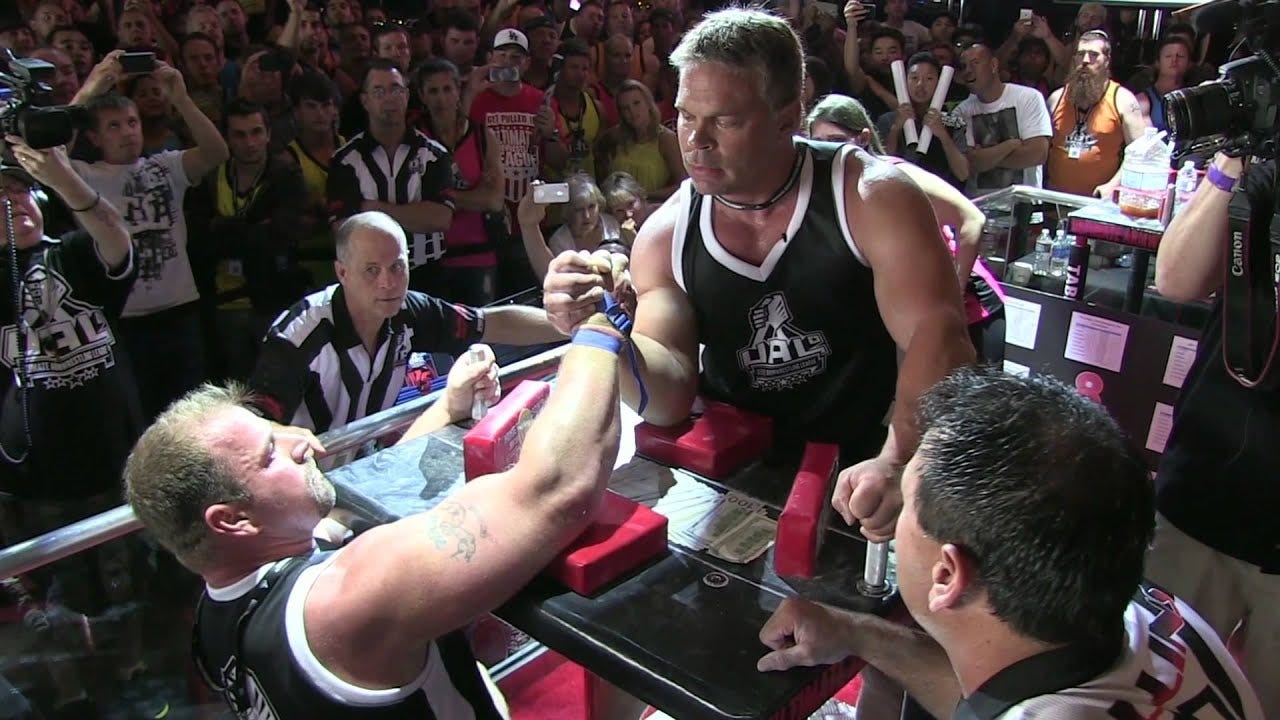
Michael Todd vs John Brzenk clearly shows the mechanics: the defensive player's arm is extended with the elbow on the pad, and the hand is pronated, twisting the opponent's wrist into a weak position.
Why It's So Controversial
The King's Move is often criticized because it can look like the puller is simply "giving up" and relying on a dangerous bone-on-bone position. Critics argue that it turns the match into a test of structural integrity rather than muscular strength and technique. However, proponents argue that it is a legitimate strategy within the rules that requires immense tendon strength, pain tolerance, and technical skill to execute without getting pinned or injured.
Love it or hate it, the King's Move is a powerful tool in a puller's arsenal. It forces opponents to adapt and find new ways to generate power against a seemingly immovable object, adding a layer of strategic depth to the sport.
Here are some of the most notable and controversial arm wrestling matches that featured the King's Move.
These matches are often cited by fans as either "masterclasses in defense" or "reasons why the rules need to change," depending on which side of the debate they fall on.
1. Michael Todd vs. Jerry Cadorette (WAL 506)
The Context: This is arguably the most famous example of the "King's Move" clashing with the "Flop Press." Jerry Cadorette is known for his massive pressing power, while Michael Todd is the master of the King's Move.
The Match: It turned into a war of attrition. Todd dropped into his King's Move, and Cadorette pressed with all his might against the bone-lock. Because Todd's arm wouldn't open any further and Cadorette couldn't drive him down to the pad, they sat in a stalemate for minutes at a time.
Why it's notable: It resulted in one of the longest rounds in history (over 5 minutes of continuous pulling in one round). It perfectly demonstrated how the King's Move can neutralize an otherwise stronger opponent by forcing the match into an endurance test.
2. Devon Larratt vs. Dave Chaffee (WAL 504)
The Context: Dave Chaffee is widely considered one of the strongest men in the sport, possessing a "freight train" style of side pressure. In a standard hook or toproll, Devon Larratt knew he likely couldn't stop Dave's power early in the match.
The Match: Devon Larratt utilized a "desperation" King's Move to catch Dave's hit. In the early rounds, Devon dropped completely under the table to stop the match. Once the stop was secured, Devon drained Dave's energy, eventually climbing back up for the pin.
Why it's notable: It showcased the tactical utility of the move. Devon didn't use it because he was injured; he used it as a specific weapon to stop a power-hitter who was physically stronger than him.
3. Michael Todd vs. Devon Larratt (WAL 406)
The Context: At this time, the heavy hammer (title) was on the line. This match is significant because it featured the two best defensive pullers in North America facing off.
The Match: This was a grueling, ugly, technical war. Michael Todd's King's Move was at its peak dominance. Devon Larratt tried everything to crack it but ultimately lost the super-match 3-2.
Why it's notable: It validated the King's Move as a championship-caliber technique. It wasn't just a gimmick for old guys; it was a wall that even the best technical arm wrestler in the world (Devon) struggled to dismantle at that time.
4. "Crazy" George Iszakouits vs. Travis Bagent (Various)
The Context: Crazy George is the "Grandfather" of the King's Move. He has been using it since the 1970s/80s. He is a much smaller man (often pulling at 160-170 lbs) who routinely beats heavyweights.
The Match: While they have pulled multiple times, any match with Crazy George is a highlight reel of the move. Against a trash-talking, explosive puller like Travis Bagent, George would let his arm extend fully, smile, and wait for Travis to gas out.
Why it's notable: It proves the leverage mechanics of the move. George has a fraction of the muscular strength of his opponents, yet his skeletal frame lock allows him to win.
5. Michael Todd vs. Denis Cyplenkov (PAL Armfight)
The Context: A rare example where the King's Move failed. Denis Cyplenkov is arguably the strongest human to ever touch a table.
The Match: Michael Todd attempted to sit in his King's Move, but Denis Cyplenkov's bicep and side pressure were so overwhelming that he simply powered through the bone lock, pinning Todd anyway.
Why it's notable: It showed the limit of the technique. The King's Move is a "force multiplier," but it is not magic. If the opponent is strong enough to break the structural frame (or literally break the arm), the move collapses.